The simplest way to count calories
There’s a particular feeling the first week of tracking gives you. You set the chicken breast on the kitchen scale, watch it settle on 152 grams, type in 251 calories, and sit back with the quiet satisfaction of someone who has this handled. Precise. Documented. A number with a decimal’s worth of authority behind it. That feeling is exactly what makes most people quit in about nine days.
It quits on them because precision only holds while the food does. Your weekday dinners cooperate: same pan, same scale, same skinless chicken breast at 165 calories per 100 grams. Then Friday shows up with a döner you didn’t cook and can’t weigh, and the habit you built on the scale has no idea what to do with it. So you log nothing, call the day a write-off, and by Sunday the whole week is one.
The overhead that kills tracking isn’t the minutes
People blame the time. But logging a meal was never the real cost; it takes about as long as answering a text. What wears you down is the standard you quietly signed up for, that a real entry means a weighed portion and a number you’d defend if someone asked. Hold yourself to that and every meal you can’t put on a scale becomes a small failure. Rack up enough small failures and stopping starts to look like the reasonable option.
The scale trains you to believe a rough number is cheating. It isn’t. It’s the only kind of number most of your meals will ever have, and the sooner you make peace with that, the longer you’ll actually keep tracking.
Your scale is more precise than your food
Here’s the part the kitchen scale won’t admit: it is more precise than the thing you’re weighing. A regular döner runs about 750 calories. The small one from the shop down the street is 580. The overloaded döner box is 950. Same word on the menu, a 370-calorie spread, decided entirely by how heavy-handed the guy with the knife was feeling. Weigh your own portion to the gram and you’ve pinned one variable exactly while the shop-to-shop swing, four times bigger, sails right past you.
Drinks pull the same trick. A “500ml beer” is 215 calories as a pilsner and 320 as an IPA. You didn’t measure which one landed in front of you. You couldn’t. So the decimal on your scale is answering a question the food already made fuzzy, and answering it with a confidence the food never earned.
roughly right, every day
log it in plain words, take the estimate, move on. no scale, no gram-hunting. on iPhone.
Roughly right, every day
The simplest way to count calories is to let the estimate stay an estimate. You describe what you ate in a sentence, take the number that comes back, and move on before you’ve talked yourself into weighing anything. Two slices of margherita and a beer, typed at the table, comes back around 755. Is it exactly 755? No. Neither was the weighed version, because you can’t put the oil under the cheese on a scale.
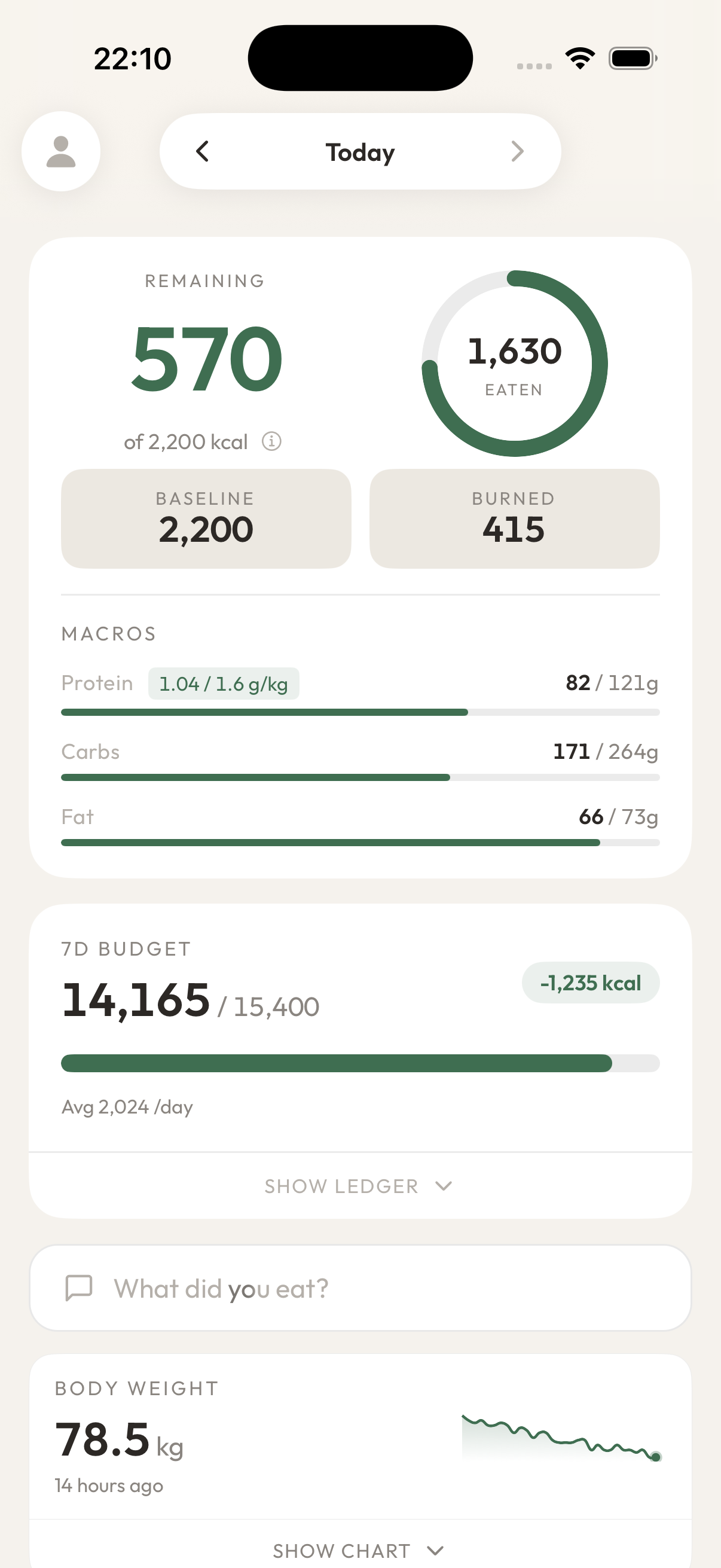
What you get instead is a day you actually finished logging. Glance at the running total once, maybe twice, and stop there. A week where every meal went in roughly tells you something real: Thursdays run hot, the work lunches are fine, the weekend is where it slides. A week with three meticulously weighed dinners and four blank days tells you nothing you can do anything with.
When the decimal actually earns its place
I won’t pretend the estimate is free. It can land 100 to 150 calories off on a big, messy plate, and if you’re a competitive lifter eight weeks out from a stage, that gap is real money and the scale earns every second you spend on it. For that person, weigh it all.
For everyone else, the ones who want to drop a few kilos or just see where the calories are actually going, that gap is smaller than the error you’re already carrying from the food itself, and chasing it is precisely what turns tracking into a test you keep failing. If the clock is your problem more than the scale, I wrote the five-minute version; if it’s the weighing specifically, tracking without a scale points the same idea straight at it.
So put the scale in the drawer for a week. Log the döner at 750, even on the Friday when you have no clue whether it was really 750 or 900, and find out whether a full week of roughly beats the half-week of perfect you keep starting over.