How to track calories without weighing your food
A kitchen scale is the quiet reason a lot of people quit tracking. Not the dramatic reason, the small one. You’re standing over a bowl of pasta, hungry, and the app wants you to tare a plate, spoon the food back out, read the grams, and type them in before you’re allowed to eat. Do that twice and the novelty’s gone. Try it in a restaurant and you simply can’t.
So here’s the honest version: you don’t need to weigh your food to track it usefully. You need a decent estimate you’ll actually record, every day, for longer than a week.
Why the scale is where people quit
Weighing has a logic to it. Grams are exact, the database wants grams, so you weigh. The catch is that it only works in one place, your own kitchen, when you cooked, with time to spare. That’s maybe a third of what you actually eat.
The rest of life shows up without a scale. The café sandwich. The handful of nuts at four in the afternoon. The dinner someone else plated for you. A tool that silently demands a weight for every entry isn’t asking for accuracy, it’s asking for an effort nobody sustains, and the predictable result is four careful days and then nothing.
Describe it the way you’d say it out loud
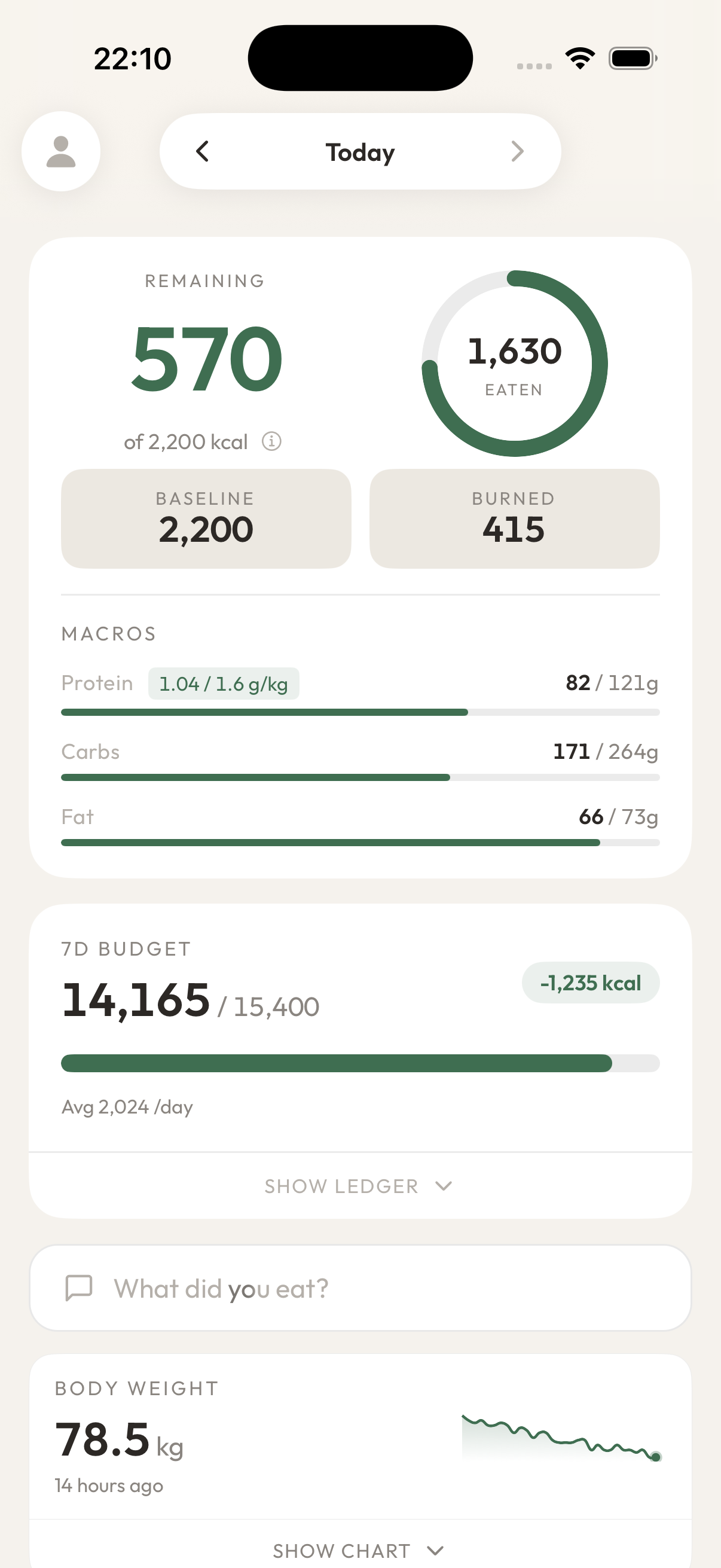
The method that survives real life is almost boringly simple. You tell the app what you ate, give it a rough portion, and it does the math.
“A tablespoon of peanut butter on toast.” “Half an avocado.” “A medium banana.” “A big bowl of pasta, about two handfuls dry.” Each of those is a sentence, not a weighing session, and the app reads it the way a person would.
You can eyeball portions far more often than you’d think. A tablespoon of peanut butter is a normal spoonful, not a lab measurement. Half an avocado is half an avocado whether it’s 140 grams or 160. A restaurant pasta is “big” or “small,” and your gut already knows which one is in front of you. The goal was never to fake precision. It’s to be roughly right on purpose, because roughly right is a number you can produce in ten seconds at the table.
no scale required
describe your plate in a sentence and get the calories back. on iPhone.
Why “roughly right” is genuinely enough
The urge to weigh comes from a belief that the gram number is the truth and your estimate is a sloppy copy of it. That belief is wrong. A packaged label is legally allowed to be off by twenty percent. Your body doesn’t absorb every calorie on the wrapper. The avocado you weighed to the gram grew in conditions no database knows a thing about. Chasing precision at the input while everything downstream is already fuzzy is mostly theatre.
What decides whether tracking works is whether you keep doing it. A rough number logged every day for two months teaches you more about your eating than a perfect one you drop after a single long Tuesday. For how the estimate gets produced, I went into that in how AI calorie tracking works; for the fastest possible habit, five minutes a day.
Keep the scale if you like it for cooking, plenty of people do. Just don’t let it become the thing standing between you and a log. The best estimate is the one you actually write down, and a sentence you can write down anywhere.