Calorie tracking for busy professionals
By Wednesday, most calorie trackers have already lost you. Not because you gave up, but because the app was built for someone with a quiet ten minutes to search a database, weigh a portion, and log each ingredient. You don’t have ten minutes. You have the thirty seconds between a meeting that ran long and the next one, and a half-eaten lunch going cold beside your keyboard.
The tool was the problem, not your discipline. Here’s the version that survives an actual workday.
A real week, not a meal-prep brochure
Tracking advice assumes a tidy life: three planned meals, weighed ingredients, a kitchen you cooked in. Your week looks nothing like it. Breakfast is a coffee you grabbed on the way in. Lunch is whatever was fast, eaten one-handed over email. Dinner is a client thing where you didn’t pick the place and never saw a nutrition number. A tracker that only works for the meal-prep version of your life is dead weight for the one you actually live, and the messy days are exactly the ones where the number tells you something.
Logging that fits the gap you already have
You describe the meal in a sentence, the way you’d fire off a quick message, and the app fills in the calories and macros.
That döner you ate walking back to the office is one line. The protein shake at 4pm, three hours after lunch, one line. The big mac grabbed between flights, logged from the gate while you wait to board, one line. No search, no scrolling forty near-identical entries, no scale you were never going to carry through security.
It comes down to speed. A log that costs ten seconds gets done in a gap you already have. A log that costs three minutes waits for a calm moment that never arrives, and by evening you’ve forgotten half of what you ate. So log it while you’re eating, not at midnight. Memory is a confident liar, and rebuilding a whole day at 11pm is slower and worse than a ten-second note in the moment.
The business dinner
Every professional who tracks hits the same wall: the dinner you didn’t choose. Set menu, shared plates, a sauce you can’t name, a host watching to see if you get weird about food. A kitchen scale is out. Searching “restaurant cream sauce, unknown quantity” is a fantasy.
This is where a plain-language estimate earns its keep. Afterward, in the taxi or before bed, you type roughly what you had: “grilled fish, potatoes, a glass of red, some bread.” Out comes a sensible number. Perfect? No. Was a perfect number ever on offer at that table? Also no. A decent estimate you record beats a precise one you skipped because the situation made it impossible.

tracking that fits a workday
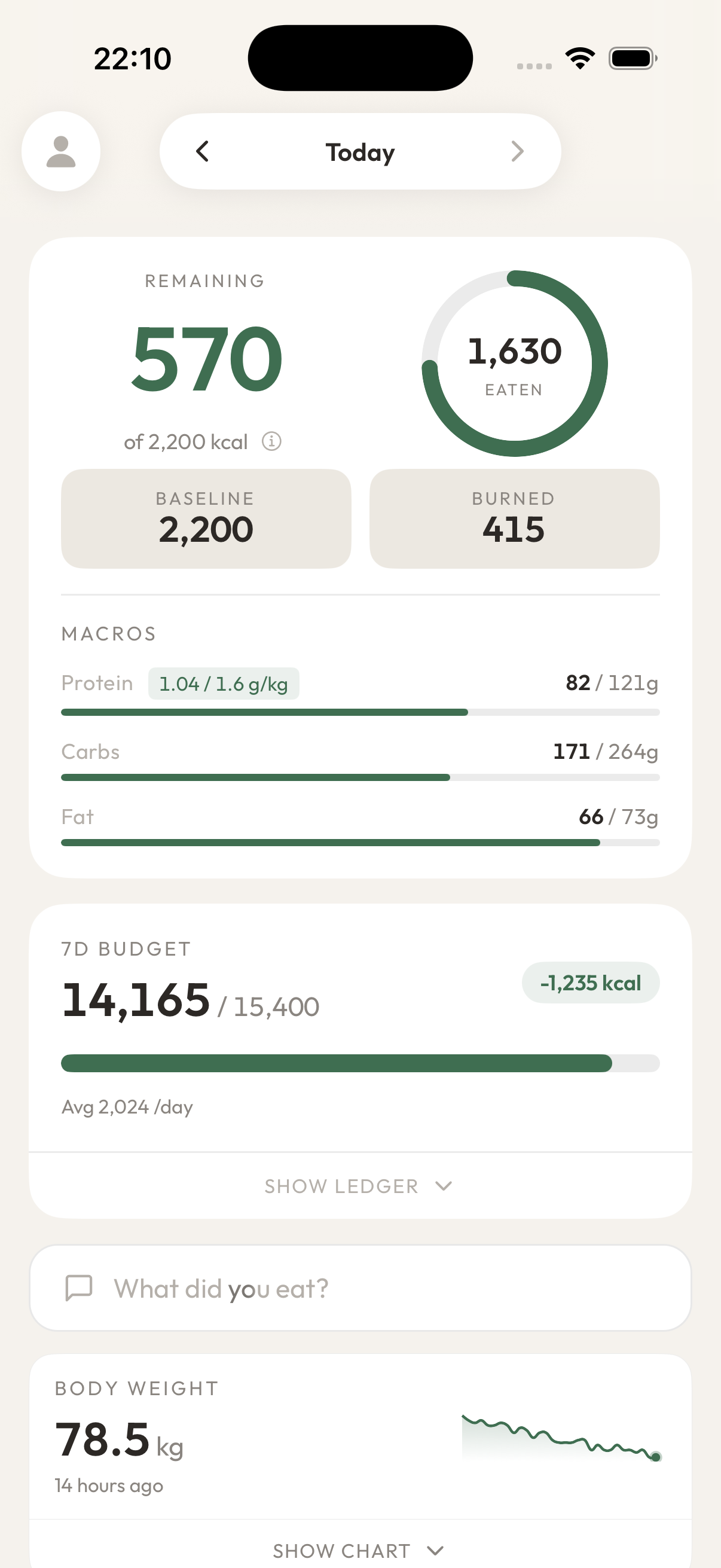
log a meal in one sentence and get back to work. on iPhone.
“Close enough” is the feature
If you’re good at your job you’ll be tempted to track with real rigor. Don’t. The label is legally off by up to 20%, your body skips some of the calories anyway, and nobody weighed the coffee with milk you drank on the way in. Precision here is effort spent in the wrong place.
A rough number you log every day for two months teaches you more about your eating than a flawless one you keep for four days and drop the week work gets hard. Tracking is meant to be the quiet background number that costs you a sentence and hands back a clearer week. For how the estimate is actually produced, see how AI calorie tracking works; for the habit, five minutes a day. The best tracker is just the one you’re still opening when the quarter goes sideways.