Your first week tracking calories
Most people who quit tracking quit in the first week, and a lot of them quit on a Friday. Monday was tidy. They weighed the oats, logged the coffee, felt like someone with a plan. Then Friday arrives with a döner they didn’t cook and can’t weigh, the number could be 580 or it could be 950 depending on how heavy the guy was with the knife, and the whole neat week suddenly feels contaminated. So they log nothing, decide they’ll “start properly Monday,” and that Monday never quite comes.
The problem isn’t the döner. The problem is that they walked in treating a rough estimate like an exam, and the first food that wouldn’t sit still on the scale felt like failing it.
Week one is not a test you can fail
Nobody tells you this at the start, so here it is: your first week of numbers is going to be rough, and it is supposed to be. You are learning what a portion actually looks like, and which meals you reliably forget to log. That is the actual job of week one. Not accuracy. Calibration.
The people who last aren’t the ones who nail it. They’re the ones who logged a mediocre estimate on the bad day and moved on. The ones who quit are usually the ones who were doing it “right,” weighing everything to the gram, right up until the first meal they couldn’t weigh, at which point the whole structure fell over because it was never built to survive a Friday.
Your numbers are shakier than you think, and it still works
Here is the part that should make you relax, not panic. Even the “precise” way is full of holes.
Search a normal food database for chicken breast and you’ll get a spread: 165 calories for 100g grilled and skinless, closer to 250 for a real 150g portion, more again if it was fried with the skin on. Same two words, “chicken breast,” and you’re already guessing which row is your dinner. A 500ml beer is 215 calories as a pilsner and 320 as an IPA, and you probably didn’t check which one the bartender poured. The döner from before swings 400 calories shop to shop. None of this is you being bad at tracking. This is what the food is actually like.
So the choice in week one was never “perfect number” versus “rough number.” It was “rough number” versus “no number.” A rough breakfast beats a blank morning every time.
What the first few days actually look like
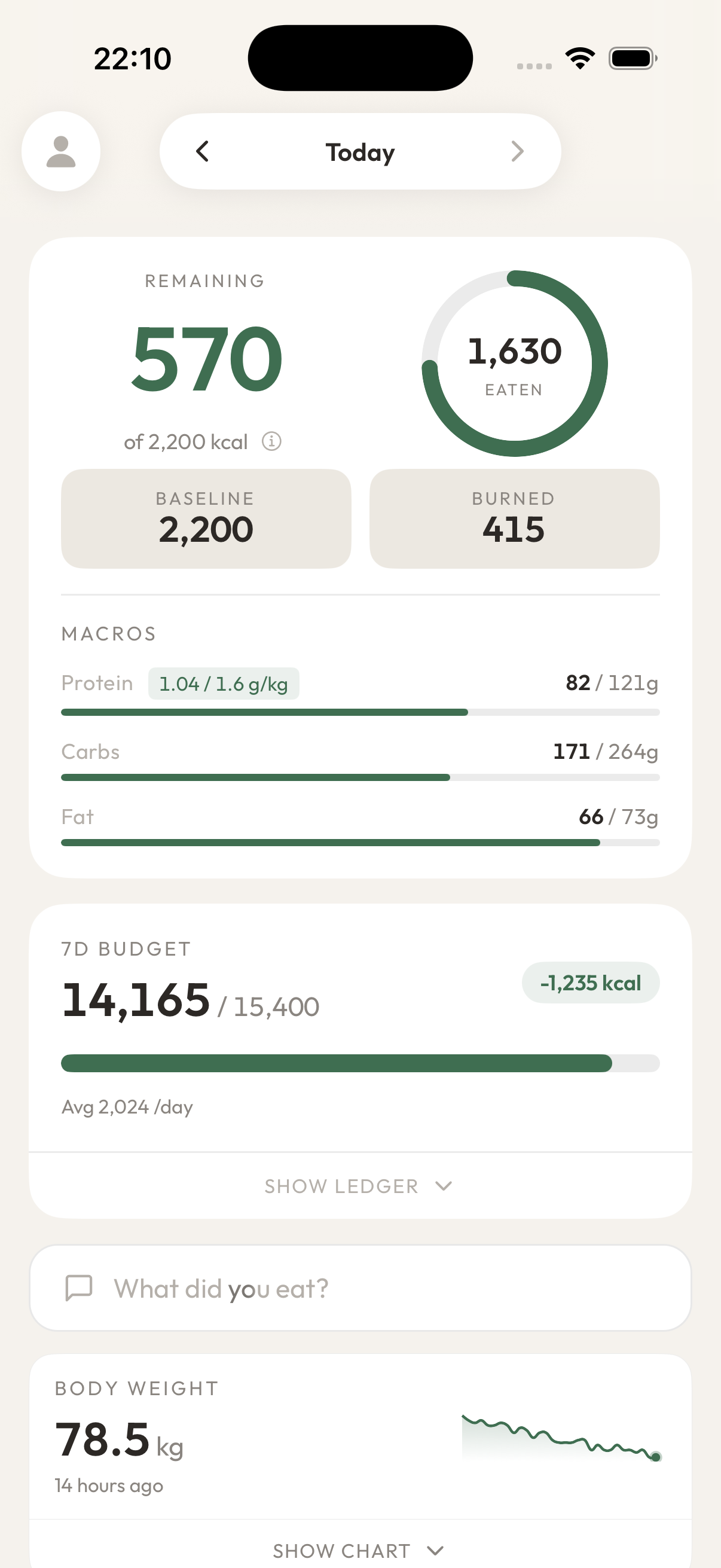
Monday you’re keen. Porridge for breakfast: 50g of haferflocken is 185 calories, plus a banana at 105, and you feel great typing it in. Dinner goes in too. Textbook day.
Tuesday you forget lunch entirely. You remember at 4pm, can’t recall if the sandwich had mayo, and stare at the app feeling like the day is already blown. It isn’t. You put in “chicken sandwich, roughly,” take the estimate, and the day is basically intact.
Then Friday, the döner. You have no idea if it was 580 or 950. You log 750, the middle, the honest shrug. And that guess, the one that felt like cheating, is the entry that keeps you tracking, because the alternative was logging nothing and letting Friday quietly end the whole experiment.
The trend survives your bad estimates
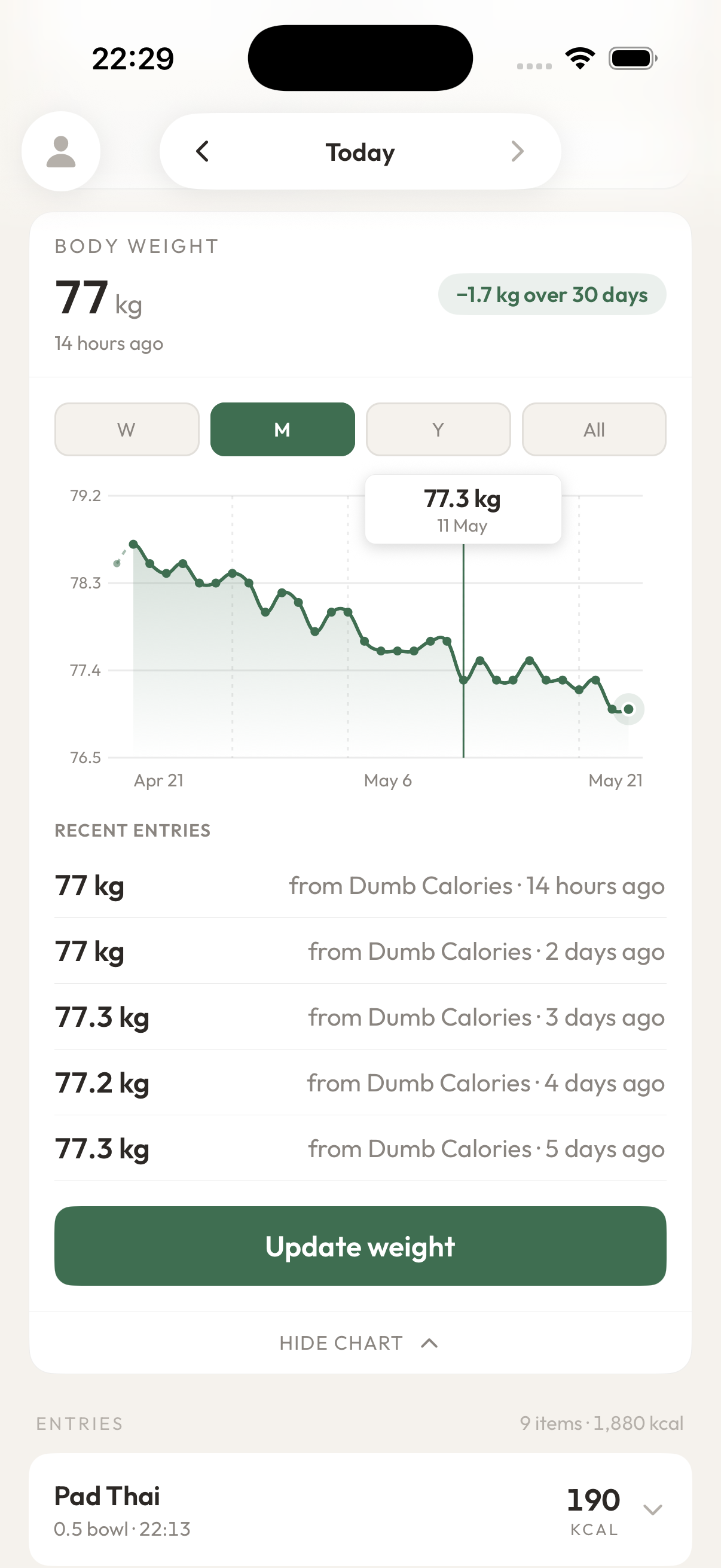
Say your week-one numbers are 150 calories off on any given day. Sometimes high, sometimes low. Feels sloppy. Here’s why it barely matters: across seven days those errors mostly cancel, and what’s left is the shape of your week. Thursdays run hot. The weekend is where it slides. Your lunches are fine. That shape is the entire point of week one, and it shows up clearly through estimates that would never survive a lab.
A perfect Tuesday tells you nothing on its own. Seven honest, slightly-wrong days tell you where your calories actually go. Only one of those is worth having, and it’s not the perfect Tuesday.

made for day one
log it in plain words, take the rough number, keep going. no exam. on iPhone.
I’m not going to pretend the estimate is free of cost. On a big, messy plate it can be 100 to 150 calories off, and if you’re a competitive lifter eight weeks out from a stage, that gap matters and you should weigh everything. For everyone else in week one, that gap is smaller than the meals you’d have skipped, and chasing it is exactly what turns tracking back into the exam you were always going to fail.
If the friction for you is time rather than nerve, I wrote the five-minute version, and if it’s the precision itself that grates, the simplest way to count calories goes straight at that.
So log the döner at 750 on Friday, even the Friday you have no clue whether it was 750 or 900. Get to Sunday with seven imperfect days instead of three perfect ones and a blank weekend, and you’ll have something week two can actually build on.