How to track calories without scanning barcodes
The barcode scanner is the feature every calorie app leads with. Point the phone at a wrapper, wait for the beep, watch the calories drop into your log. The first time it works it genuinely feels like the future showed up early. Then you cook actual dinner, some chicken breast, a scoop of rice, whatever vegetable was in the fridge, a glug of oil, and you’re standing there holding your phone over a plate that has nothing on it to scan.
That’s the flaw nobody mentions while they’re selling you the scanner: a barcode only exists on a package. The chicken came in plastic you already binned, and it was loose from the butcher counter anyway. The rice was scooped from a bag you opened in March. An apple has never worn a barcode in its life. Most of what a person eats in a day, the home-cooked stuff and the meals someone else plated for you, shows up without one, so the scanner sits there useless for exactly the meals that make up the bulk of your eating.
The scan only ever answers the easy half
Logging a meal is two questions. What is it, and how much of it. The barcode answers the first, and only for the sliver of your food that arrived sealed in a wrapper. It does nothing about the second.
Scan a chocolate bar and the app reads 540 calories per 100 grams, confident as anything. Fine. You ate four squares standing at the kitchen counter, which is maybe 25 grams, or maybe 40, and the beep told you nothing about which. You’re back to eyeballing the portion, the precise chore the scan was supposed to spare you. So it nailed the easy half of an easy food and handed you the hard part anyway.
Describe the plate instead of hunting for a label
The method that covers everything you eat, not just the packaged fraction of it, is to say what was on the plate. In plain words.
“Grilled chicken breast about the size of my palm, a cup of rice, a pile of broccoli, a spoon of oil.” “A bowl of oats with a banana and a spoon of peanut butter.” You type it the way you’d tell a friend what you had, and the app reads the sentence: the chicken and rice are the easy part, the oil is what really swings the number, here’s the total. No wrapper needed, because you described the food and not its packaging.
That oats bowl runs about 385 calories: the oats near 185 for a normal 50-gram scoop, a banana at 105, the peanut butter around 95. You scanned none of the three. To do it the old way you’d have hunted down a barcode on the bag, found no barcode at all on the loose banana, dug out the jar, and you’d still be guessing how heaped the spoon was. One sentence covered all of it.
nothing to scan
describe the plate and get the calories back. no database, no scale. on iPhone.
A scan-first tracker quietly changes what you eat
What actually bothers me about scanner-led tracking is subtler than the friction. A tool that makes packaged food effortless and fresh food a fight is nudging you, gently, toward the packaged food. The things with a barcode are the things in a wrapper, and the things in a wrapper skew toward the processed end of the shelf. When a labelled yogurt logs in one beep and the chicken and rice you actually cooked means wrestling a search box, you feel the pull toward whatever scans clean. A tracker has no business having an opinion on whether you cook.
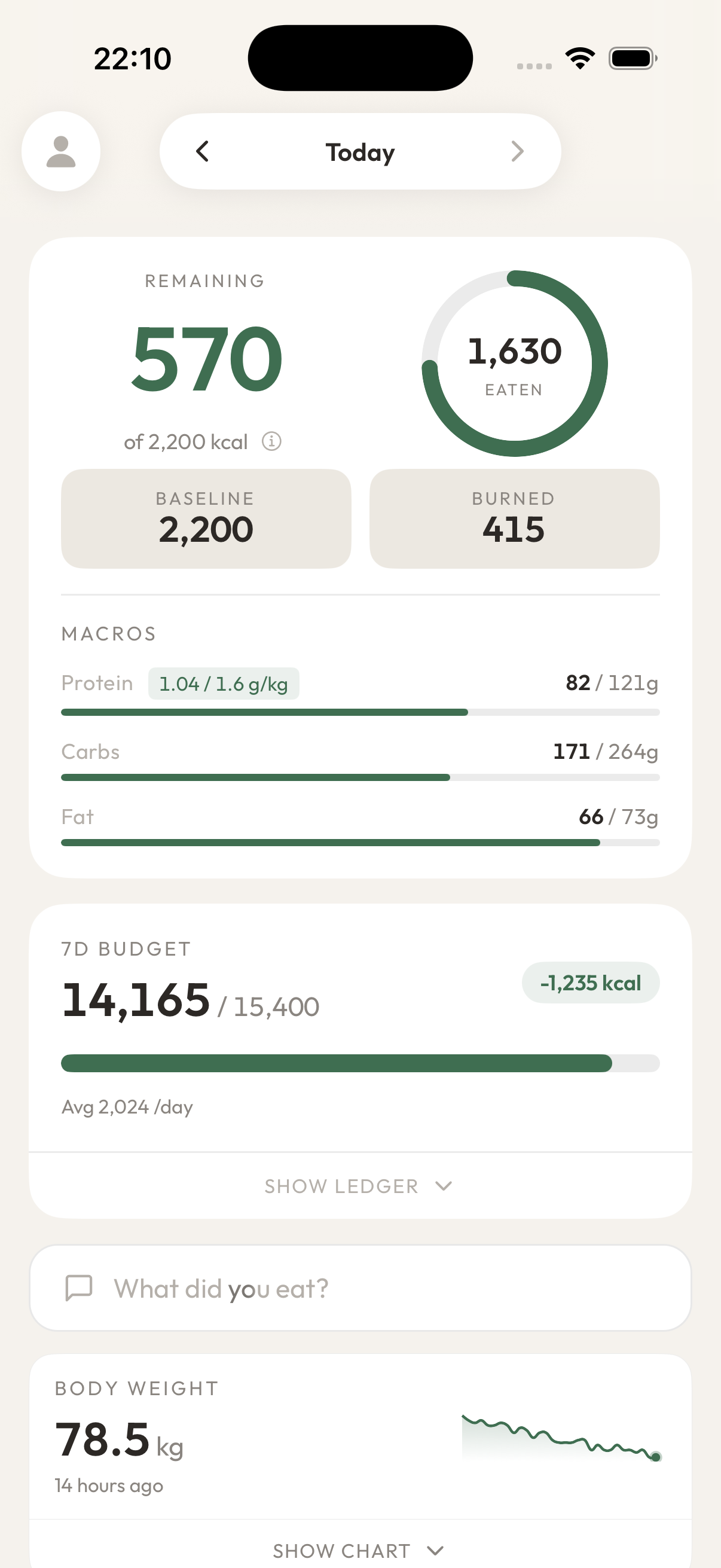
The honest caveat: for that one sealed item, the barcode really is more precise than a guess. If most of your food comes packaged and you weigh your portions, scanning is a perfectly good input, and I’m not going to pretend the number off the label is worthless. It answers a question you mostly don’t have, for food that’s mostly the easy kind, and it goes quiet the second you sit down to something a kitchen made. The portion matters more than the label does either way. I got into why “roughly right” beats a precise number you quit after a week in tracking without weighing your food, and how a sentence becomes calories in how AI calorie tracking works.
So next time you’re standing over a plate you cooked yourself, phone in hand, looking for a barcode that was never going to be there, don’t. Tell it you had chicken, rice, and too much oil, and get on with your evening.