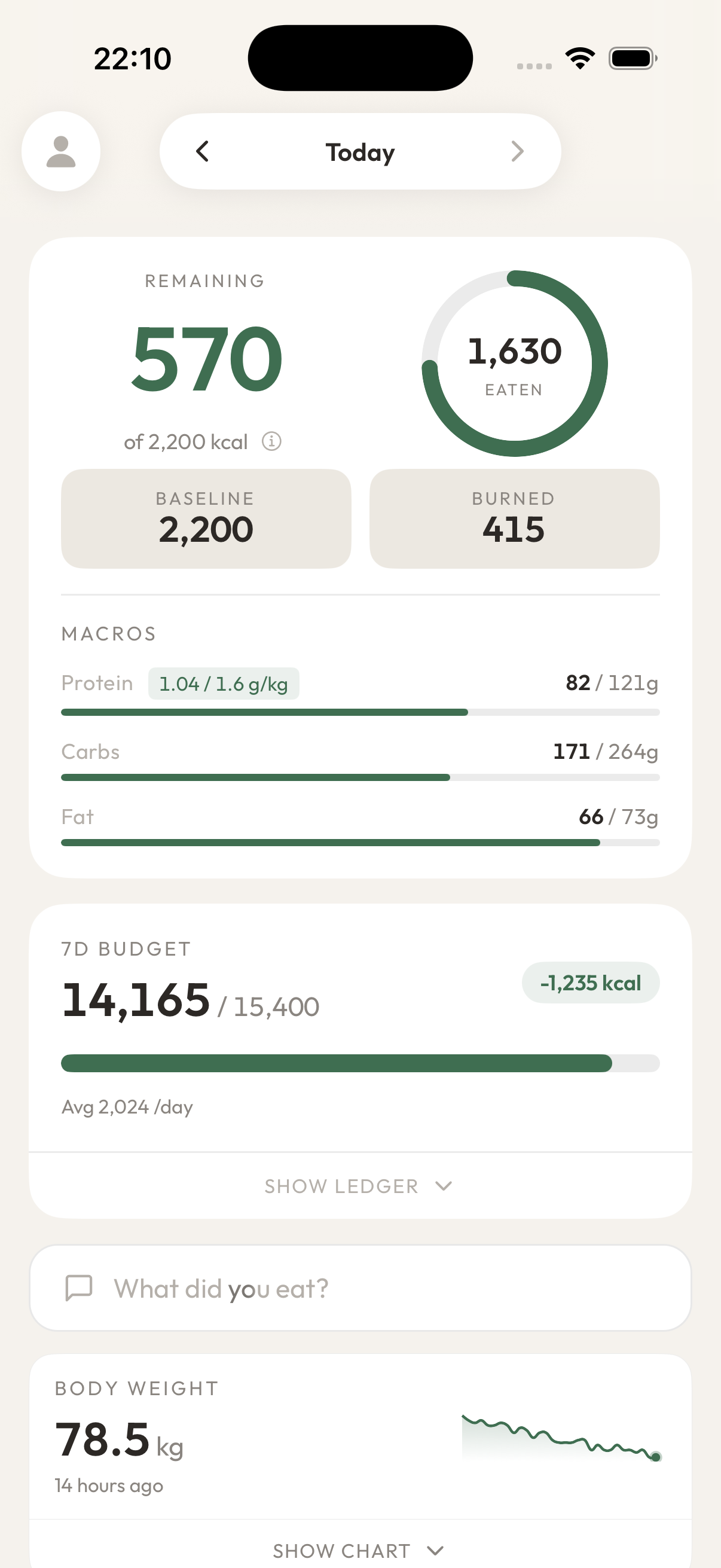
How to track calories without a food database
Type “chicken breast” into the search box of a normal calorie app and you get a wall. Forty rows, maybe more. “Chicken Breast, Grilled.” “Chicken breast, raw.” “CHICKEN BREAST (generic).” A dozen branded ones. Somebody’s home entry called “chicken breast dinner yum” that they saved in 2019 and forgot about. Every one of them is a different number, and the app is now waiting for you to pick the right one, as if you have any way of knowing which stranger’s guess matches the piece of meat on your plate.
That’s the part the “millions of foods in our database” pitch skips over. A chicken breast grilled and skinless is about 165 calories per 100 grams. That’s the real figure. But the search results won’t hand you one honest number, they’ll hand you a spread: a raw entry near 110, a fried-with-skin one up past 230, and a fistful of user-submitted rows in between that could mean anything. You don’t scroll that list and find the truth. You scroll it and make a bet.
The database moved the guessing, it didn’t remove it
Here is the thing nobody says out loud. The whole point of a food database was to make logging accurate. Look it up, get the exact number, done. But a database built from millions of crowd-sourced entries doesn’t give you an exact number. It gives you forty of them and a decision.
So the guesswork never went anywhere. It just changed shape. It used to be “how much of this did I eat,” which is a fair thing to estimate because you’re the one who ate it. Now it’s “which of these forty rows is closest to my dinner,” which you answer by squinting at a list of numbers other people typed for meals you never saw. And this second guess feels precise, because it’s a specific figure pulled from a database, so people trust it more. It usually deserves it less.
The homemade problem the search box can’t solve
Say you made spaghetti bolognese. Your version, from your kitchen. There is no row for that. There cannot be, because nobody logged your pot.
What the app offers instead is somebody else’s “Spaghetti Bolognese,” which is their recipe, their portion, their idea of how much oil goes in. Or it tells you to break the meal into parts and search each one: the pasta (130 calories per 100 grams cooked, though a real plate is closer to 200 or 300), the mince, the tin of tomatoes, the splash of oil, the parmesan you grated by feel. Six searches, six lists, six little bets, for one bowl of pasta. Most people do exactly two of those and quietly give up on the third.
Describe it instead of hunting for it
The way out is to stop searching a list and just say what you ate. In a sentence.
“A bowl of spaghetti bolognese, big portion, homemade.” “A pot of greek yogurt with honey and a handful of granola.” You type it the way you’d tell a friend, and instead of returning a list for you to sort through, the app reads the sentence and gives you one number. The greek yogurt is around 90 calories for a 150-gram pot at zero percent, the honey and granola push it up, here’s the total. You never touched a search box. There was no list of strangers’ entries to disagree with, because you described your food and not a database’s idea of it.
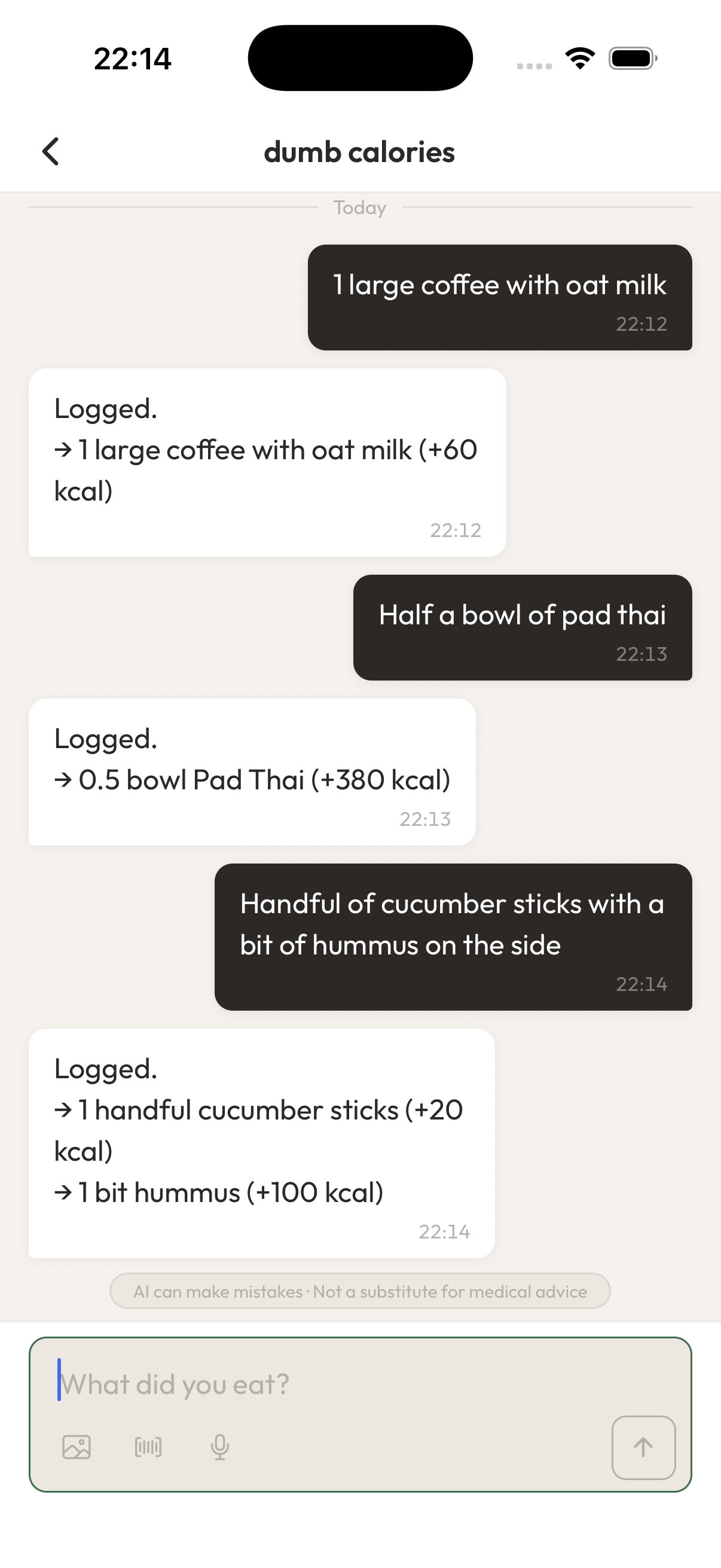
You still control the precision, the same way you always did. “Some pasta” gets a rough number. “About 250 grams of pasta with a beef ragù and a bit of parmesan” gets a sharper one. The difference is that the effort goes into describing your actual meal, not into auditing which of forty look-alike rows to trust.

no search box
describe the food in a sentence and get one number. no database to dig through. on iPhone.
When the database is actually right
I’ll be fair to the thing I’m complaining about. For one specific packaged product, a can with the manufacturer’s own numbers on it, the database entry is genuinely accurate, and often more accurate than my guess. If your day is mostly branded, boxed food, searching for it works fine. The label is real and the entry matches it.
The trouble starts the moment you cook. The food you make at home has no official entry, and the food someone else cooked for you has forty unofficial ones, and neither case is served by a search box that assumes your dinner already lives in a list. A cup of white rice is about 130 calories whether or not anyone bothered to enter it. If the barcode is your sticking point rather than the search, I wrote about tracking without scanning, and the weighing question is the other half of why “roughly right” beats a precise number you abandon.
So next time the search box hands you forty rows and a shrug, close it. Tell it you had a big bowl of spaghetti bolognese, and go eat the spaghetti bolognese.